A fire door is a tested assembly, not a thick door
It performs as it was tested, with the hardware it was tested with. Every item fitted to it either sits inside that evidence or breaks it.
What we check, door by door
Four questions, on every fire door on the job- Hinge grade against leaf mass. A 54mm FD60 leaf with a vision panel and a kick plate is heavy, and hinges rated for a 60kg test door will pass a showroom and fail a corridor.
- Closer power against the seals it has to shut against. The door has to close from any angle, against the latch, the smoke seals and any pressure difference.
- Intumescent sizing against the door’s own test report. More is not safer. A seal wider or thicker than the tested arrangement is a change to a tested assembly.
- Exit device against who is behind the door. Panic hardware where the public is, emergency exit hardware where the users are trained. It is not a preference.
Where it all has to go
FD30S single leaf, 926 × 2040 × 44Approved Document B and BS 8300-2 want opposite things from the same leaf.
One needs the door to shut itself from any angle against the latch, the seals and any pressure difference. The other caps the force it may take to open. On a heavy FD60 leaf, no amount of specifying makes that tension disappear.
Maximum opening force at the leading edge, BS 8300-2
30N
The accessibility limit, from closed to 30 degrees.
What resolves it is usually not a bigger closer. It is an angle seal fitted as an independent item in the frame rather than a seal adding friction to the leaf, so the opening force drops without losing the smoke performance. Where that is still not enough, BS 8300-2 routes to a swing-free or hold-open device to BS EN 1155, or to a power operated door to BS EN 16005. That is a design decision with a cost, and it is cheaper at Stage 3 than on a snagging list.
The rest of the figure No more than 22.5N from 30 to 60 degrees. Backcheck preferably not before about 80 degrees. Maximum closing force between 0 and 15 degrees.
Measuring it Force is hard to read at the door edge, so it may be taken in line with the handles, up to 65mm from the edge, and the figures increased by up to 2N.
One size does not fit all Intumescent dimensions come from the door’s own test evidence. More intumescent is not automatically safer, and a seal wider or thicker than the tested arrangement is a change to a tested assembly.
A detail worth two jobs at once Where a door is held open into a corridor the leading edge has to contrast visually with the face. A contrasting intumescent seal at least 15mm wide, set in the door edge, satisfies the fire requirement and the accessibility one with a single item.
What a hinge code tells youBS EN 1935, single-axis hinges. Four of the eight digits.
- 1
- 4 Category of use. Severe duty. Anything less does not belong on a fire door.
- 3
- 6 Test door mass. Up to 120kg. This is the digit that catches people out.
- 4
- 1 Suitable for fire and smoke doors, subject to assessment in the specified assembly.
- 8
- 14 Hinge grade. 200,000 cycles at 160kg.
A 54mm FD60 leaf with a vision panel and a kick plate is heavy. Hinges rated for a 60kg test door will pass a showroom and fail a corridor. On fire and escape doors the Guild is specific: severe duty, grade 12, 13 or 14.
There is no such thing as a UKCA marked lever handle.
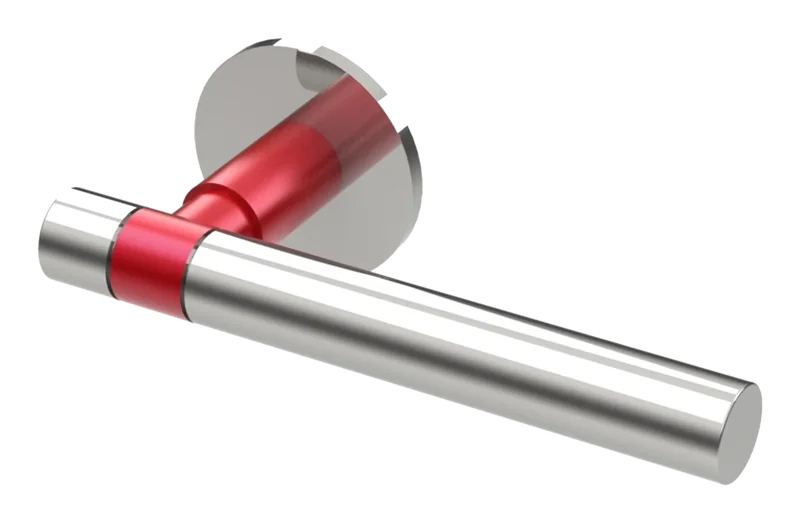
Lever handles are classified against BS EN 1906, but the Guild states plainly that conformity marking of product to that standard is not permitted. Hinges, closers, locks, panic and emergency exit hardware do carry marking. Levers do not. Where a supplier tells you otherwise, it is worth asking what else they have misread.
What the answer looks like
One set, applied to every door that carries it- 3Ball bearing butt hinge, 102 × 76 × 3, grade 14SSSBS EN 1935
- 1Mortice sashlock, 72mm centres, 57mm backsetSSSBS EN 12209
- 1Euro cylinder, master keyed to suite MK‑ASCBS EN 1303
- 1Lever on rose, 19mm section, return to doorSSSBS EN 1906
- 1Overhead closer, cam action, power size adjustable EN2 to 4SSSBS EN 1154
- 1Intumescent and cold smoke seal set, leaf edge, 15mm contrastingn/aBS 8214
- 1Fire door keep shut sign, both facesn/aBS 5499-4
Every line carries the standard it is classified against, so the evidence travels with the specification instead of sitting in a folder. How a schedule is put together
Send us the fire door schedule.
We will tell you which lines break the door’s test evidence, before it goes to tender.
Monday to Friday, 8:30 to 17:00. Or forward the whole email thread to drawings@prolinesales.co.uk.